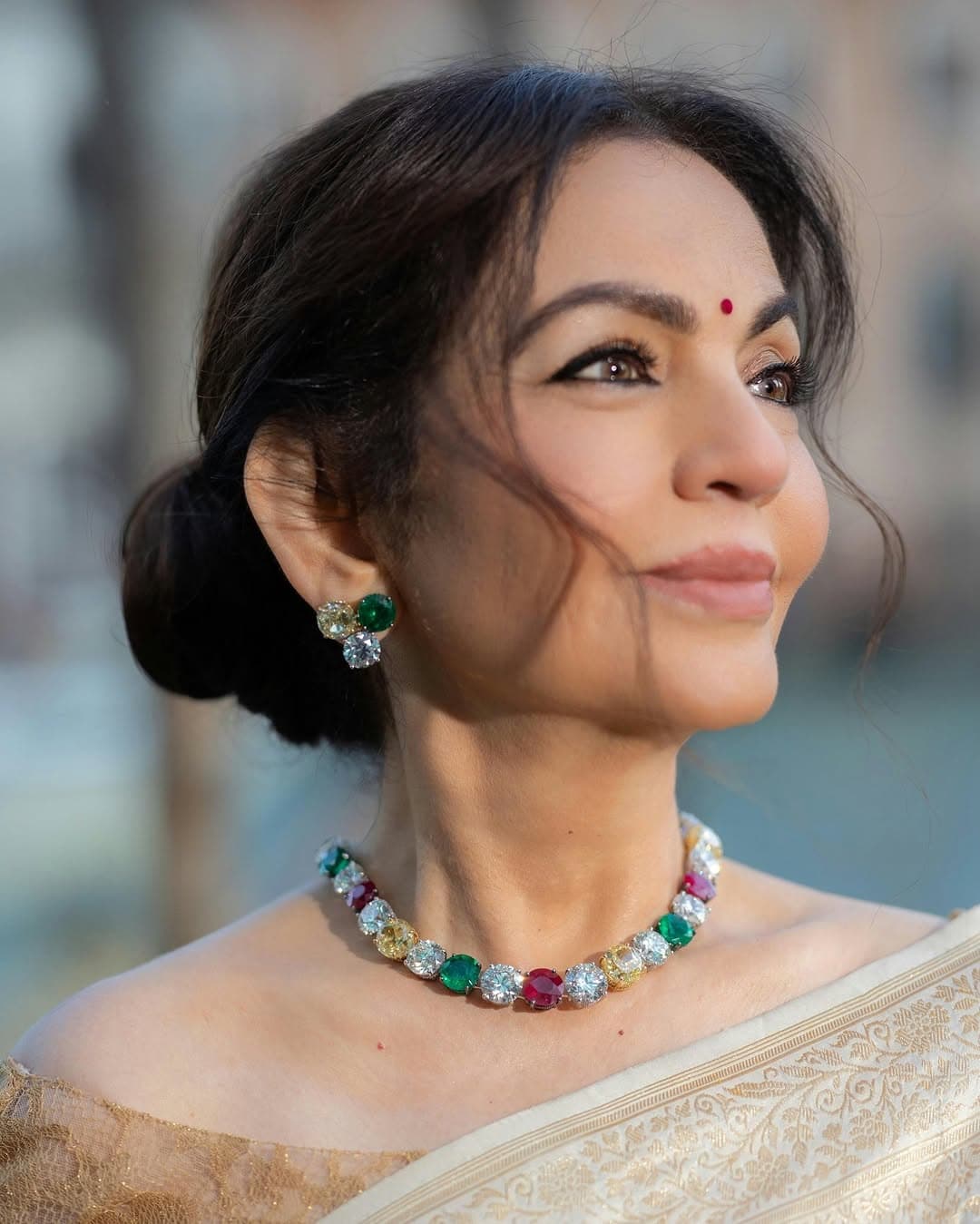
There are jewels that decorate, and then there are jewels that take up space the way a work of art does, with presence, argument, and a point of view. At the Venice Biennale 2026, Nita Ambani in Kantilal Chhotalal is not simply a beautifully dressed woman photographed against cultural gravitas. She is the rare kind of patron for whom objects are chosen with the same discernment as a collection, and worn with the same intention as a public statement.
Kantilal Chhotalal’s newest high jewellery offering for Mrs. Ambani is called The Ratna Rivière, a necklace and earrings conceived as much for the world as for the wearer. The name does the heavy lifting without strain, ratna, Sanskrit for precious jewel, meets rivière, the classical necklace form that reads like a continuous river of stones. Indian meaning, global technique, and an attitude of quiet command, all in one line.
Nita Ambani in Kantilal Chhotalal, and why Venice matters
Venice has a way of clarifying things. The Biennale is not a red carpet in the traditional sense, it is a moving gallery of ideas, reputations, and visual language. What you wear there can feel like a footnote, unless it is calibrated to stand beside the art rather than compete with it. In that context, The Ratna Rivière reads as considered cultural punctuation, not ornament.
This is also where Mrs. Ambani’s long arc as a patron comes into focus. As founder of the Nita Mukesh Ambani Cultural Centre, she has made a practice of bringing Indian creative excellence into rooms that historically only made space for it on the margins. Venice is one of those rooms, and a jewel can be a surprisingly eloquent instrument when it is worn by someone who understands social capital and visual symbolism as intimately as she does.
A rivère that refuses to be background
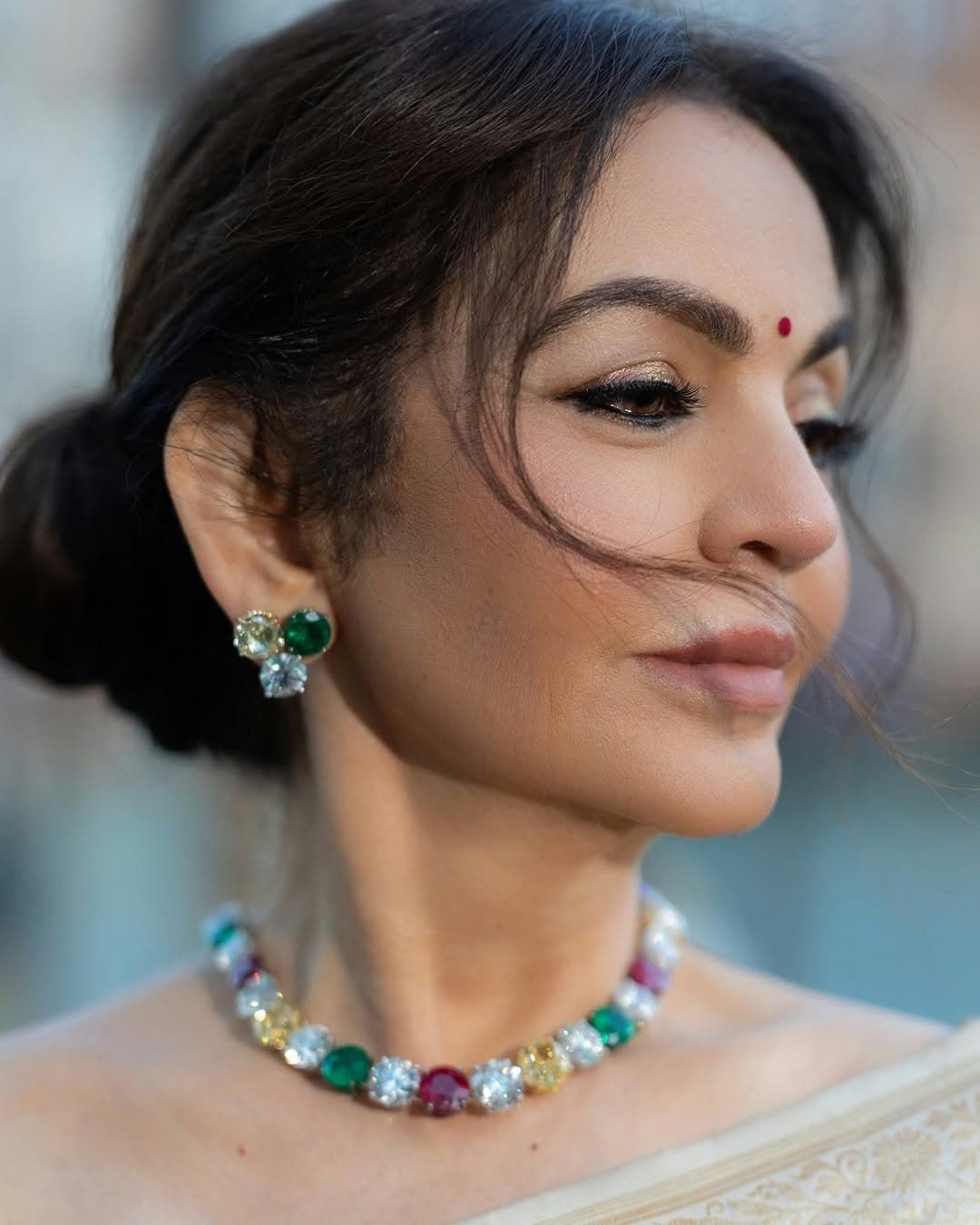
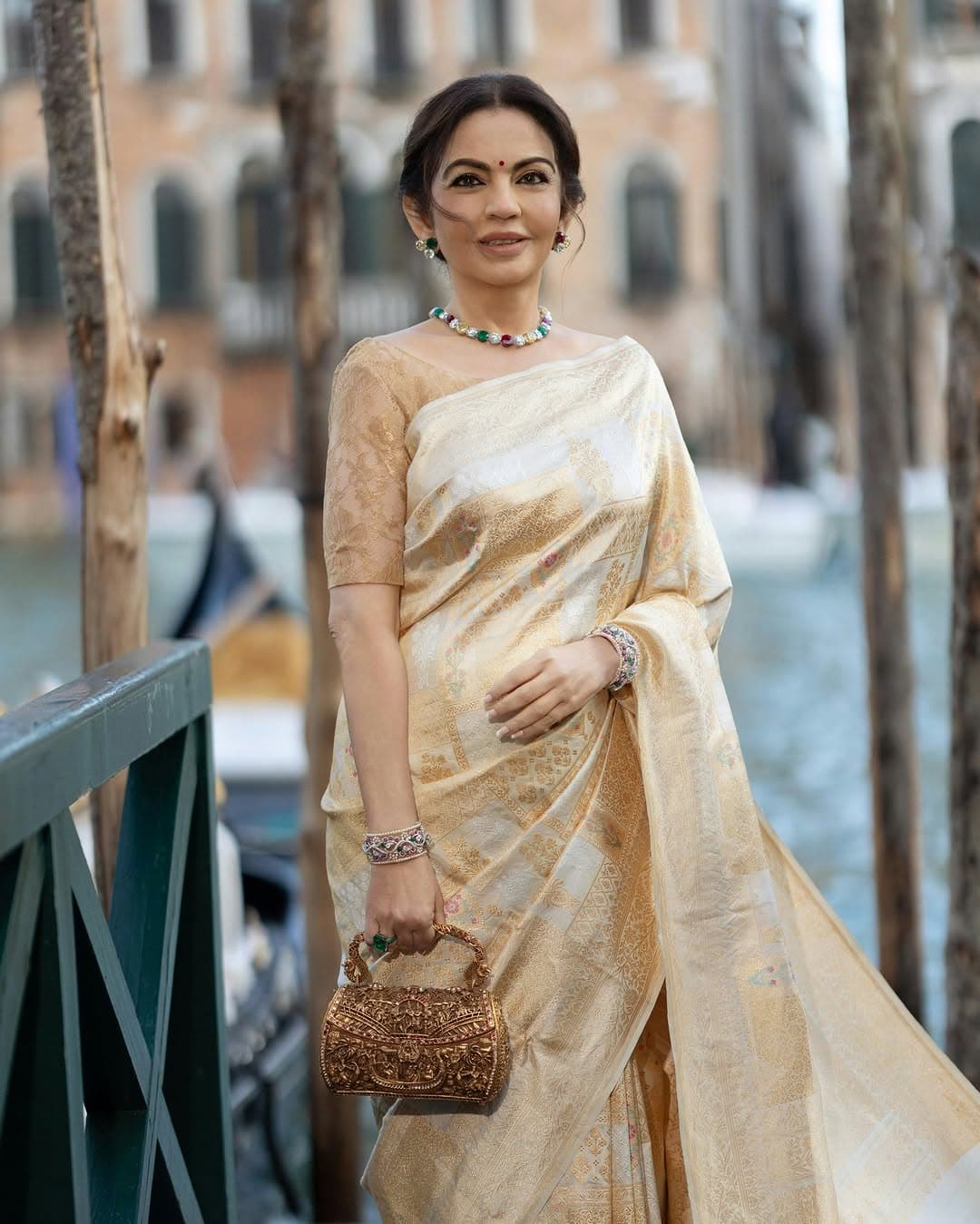
At first glance, the necklace reads with the kind of classical assurance high jewellery lovers recognise immediately. Then your eye starts to register what is actually happening, a procession of perfectly matched 10 carat round white diamonds, vivid yellow diamonds, Colombian emeralds, and Burmese rubies in that most coveted pigeon blood red. Not clusters. Not mixed cuts designed to distract from unevenness. Rounds, matched, repeated, disciplined.
The audacity is not only in the beauty but in the premise. Gathering round coloured gemstones of this quality and quantity across all three colours is, by any serious standard, unprecedented. Each stone was sourced, studied, and in many cases recut to achieve the exact scale, proportion, and rhythm the piece demanded. This is not styling. This is connoisseurship.
The secret lives at the back
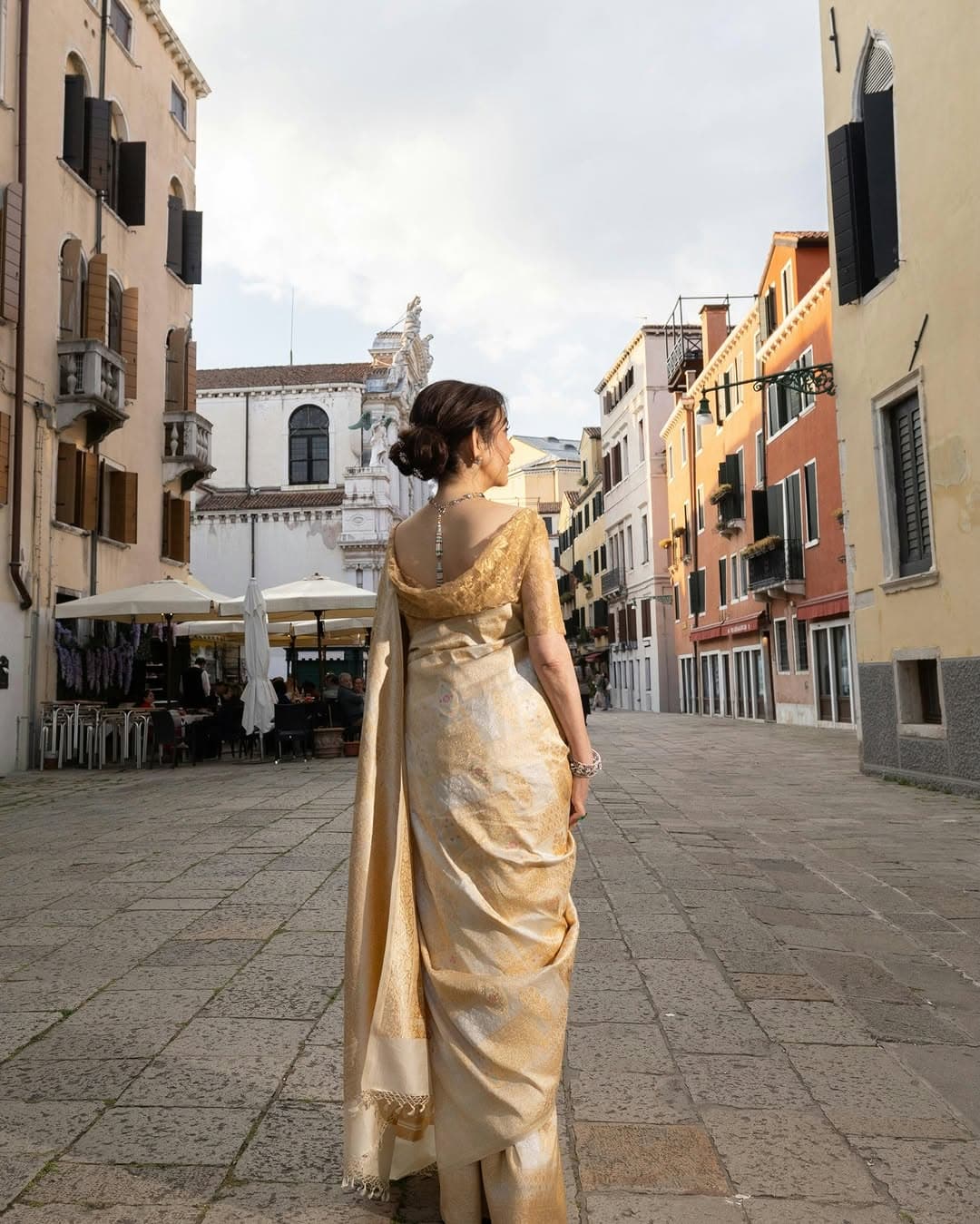
The most intelligent pieces always reward attention. Here, the greatest secret belongs to the back, where two magnificent briolette and bead tassels fall one into the other. It is a cascade of colour and light, a closing note that makes The Ratna Rivière as breathtaking from behind as from the front. In a Biennale crowd, where people are always turning, greeting, leaning in, that detail becomes its own kind of theatre.
The Ratna Rivière as high jewellery, curated not assembled
High jewellery is often described as craftsmanship, which is true and also insufficient. Craft is the hand, but great high jewellery is the eye, the edit, the patience. This piece was not assembled, it was curated stone by stone over two years, personally by Mrs. Ambani. That changes the energy of the object. It becomes less a brand’s declaration and more a collector’s signature, built from a series of decisions only a seasoned custodian of beauty would insist upon.
To understand that distinction, it helps to place Kantilal Chhotalal in a broader conversation. The house’s work belongs to a particular Indian lineage of refinement, where the drama is controlled and the engineering is invisible. If you are looking for context on the language of high jewellery today, it is worth spending time with how major maisons formalise it, Cartier remains an instructive reference, as does the way institutions like the Venice Biennale frame objects within contemporary culture.
For readers who follow this intersection of fashion, collecting, and cultural power, you will find more of our coverage in Luxury, as well as our ongoing lens on exhibitions and patrons in Culture. And because a jewel at this level is never fully separable from the person wearing it, our Celebrity coverage tracks the way style becomes diplomacy.
Deliberate asymmetry, and the confidence it signals
The earrings extend the necklace’s intention with a choice that separates collectors from clients, deliberate asymmetry. One earring pairs white, red, and yellow stones, the other brings together white, green, and yellow. It is not the kind of mismatch that begs to be explained. It is the kind that assumes you will understand that rarity speaks in its own register, and that harmony can be far more profound than symmetry.
In the narrowed air of Biennale conversation, where everyone has an opinion and precious few have taste, that asymmetry becomes a quiet flex, the sort that reads as ease rather than effort. It also speaks to a very Indian understanding of adornment as narrative. The stones are not only colour, they are symbols, histories, and geographies, carried lightly but not casually.
When jewellery holds its own beside art
What makes Nita Ambani in Kantilal Chhotalal at Venice Biennale 2026 genuinely compelling is that the jewel does not ask the art to validate it. It arrives with its own internal logic, its own scholarship of material, its own choreography of light. The Ratna Rivière belongs to the rare category of adornment that transcends the body and becomes an object with civic presence, something that can be discussed the next morning in the same breath as a pavilion you cannot stop thinking about.
That is the thing about the best patronage. It is not loud, and it is not neutral. It is a form of authorship. In Venice, Mrs. Ambani is not merely attending a global cultural moment. She is helping define what India’s cultural voice looks like when it refuses to be translated down.
Photo Credits
Cover image courtesy of Kantilal Chhotalal. Additional images courtesy of their respective owners.