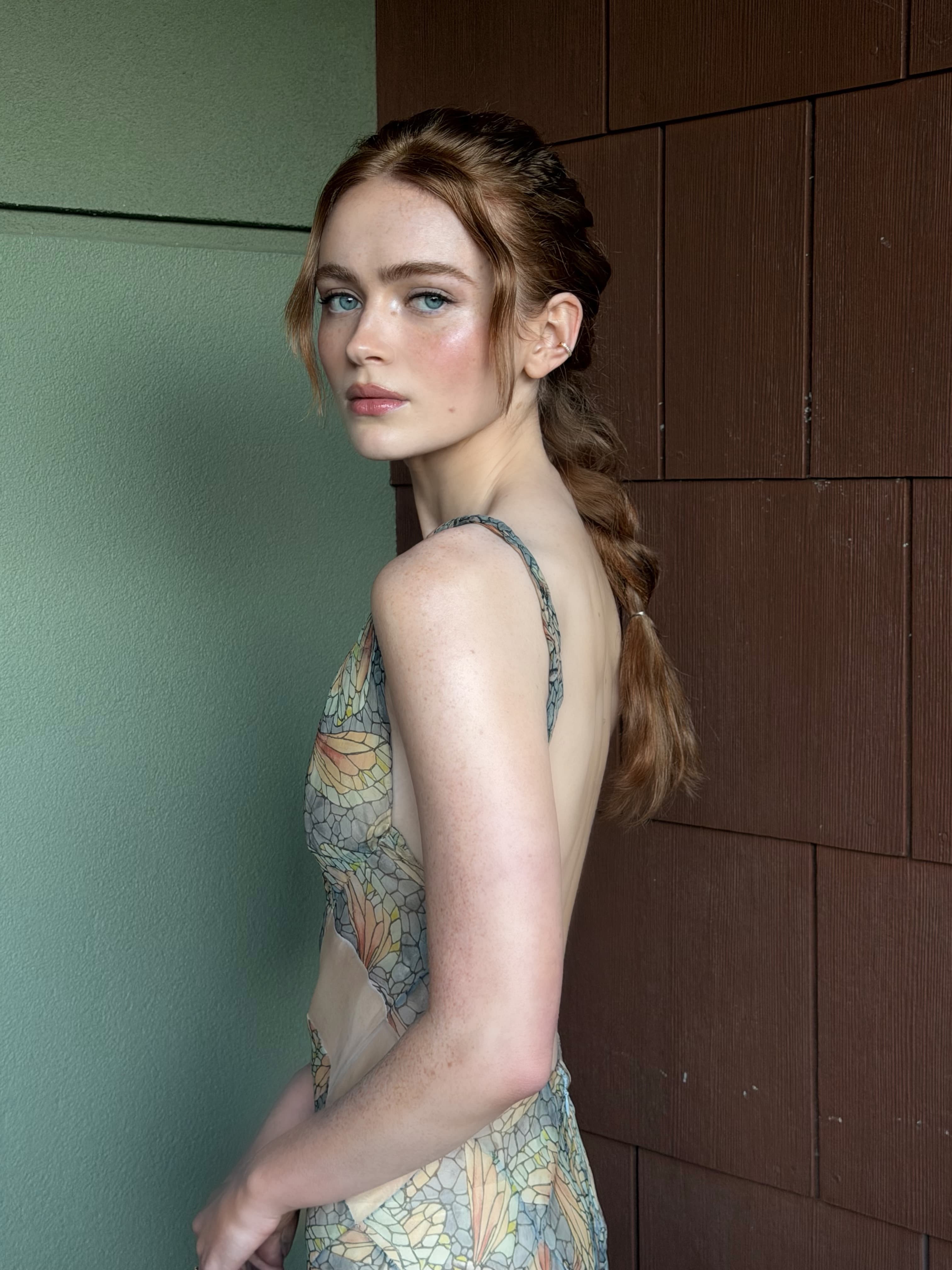
There is a particular thrill when a red carpet look does not try to look new. For Disney’s D23, Sadie Sink stepped out in archival Alexander McQueen Spring Summer 2004, a choice that lands with the satisfying snap of fashion memory being reactivated in public. The point is not nostalgia, it is precision: a period McQueen silhouette brought back into focus by a team who understands that archival only works when every modern decision around it is just as intentional.
Why archival Alexander McQueen SS 2004 still hits

Archival Alexander McQueen SS 2004 comes from Lee Alexander McQueen’s early 2000s output, an era collectors chase for its rigorous cut and its appetite for drama that feels structural rather than decorative. Wearing that season in 2026 reads as a declaration that clothing can carry history without becoming costume, especially when the wearer is someone like Sink, whose career has been built on characters with a pulse and a point of view.
Sink’s D23 appearance is also a reminder that the archive conversation is changing. It is less about “vintage for vintage’s sake” and more about authorship: you wear McQueen because you want McQueen’s line, not an approximation of it.
Disney D23, Jean Grey, and styling that understands narrative
The caption’s “Jean Grey” nod matters. D23 is where Disney makes its fan facing promises in a room full of long memories, so dressing a performer in archival Alexander McQueen SS 2004 is a strategic kind of theatre. It signals seriousness, and it signals a willingness to meet a big franchise moment with something sharper than the usual premiere uniform.
That story cleanly aligns with what D23 is, officially: the Disney fan club created in 2009, whose flagship expo has become the company’s stage for announcements and talent appearances. Disney explains the D23 name as a reference to 1923, the year the company was founded. You can verify that framing directly via D23’s official site.
The glam team behind the archive
If the dress is the headline, the supporting credits tell you how the effect was built. Hair is credited to Ryan Richman, makeup to Yukari, with styling by Lilyanne S, Paige Holtz, and Ashley Afriyie, and Molly Dickson tagged as well. That roster reads like a modern red carpet operation treating archival with respect, which is to say, not “handling it carefully,” but making sure it still feels alive under lighting, flash, and the strange intimacy of internet zoom.
In other words, archival Alexander McQueen SS 2004 does not succeed here because it is rare. It succeeds because the entire look was composed to let the garment be legible as McQueen, while still looking like Sadie Sink in the present tense.
What this signals for celebrity dressing right now
Archive dressing is becoming a sharper language on major stages, and D23 is a particularly telling one, because it is built on canon and continuity. Sink in archival McQueen suggests a new red carpet hierarchy: the best looks are not the newest samples, they are the ones with an argument, backed up by a reference you can trace.
For readers who want to place this within McQueen’s broader house history and runway-to-red-carpet afterlives, the brand’s own timeline and codes are best understood starting at Alexander McQueen’s official site.
If you are tracking the season’s most interesting fashion signals, keep an eye on who goes archival next, and whether they choose pieces that behave like sculpture rather than “a vintage moment.” This one did.
Photo Credits
Cover image and additional images courtesy of their respective owners. Look credited in caption to Sadie Sink, archival Alexander McQueen SS 2004; hair by Ryan Richman; makeup by Yukari; styling by Lilyanne S, Paige Holtz, and Ashley Afriyie; with Molly Dickson tagged.