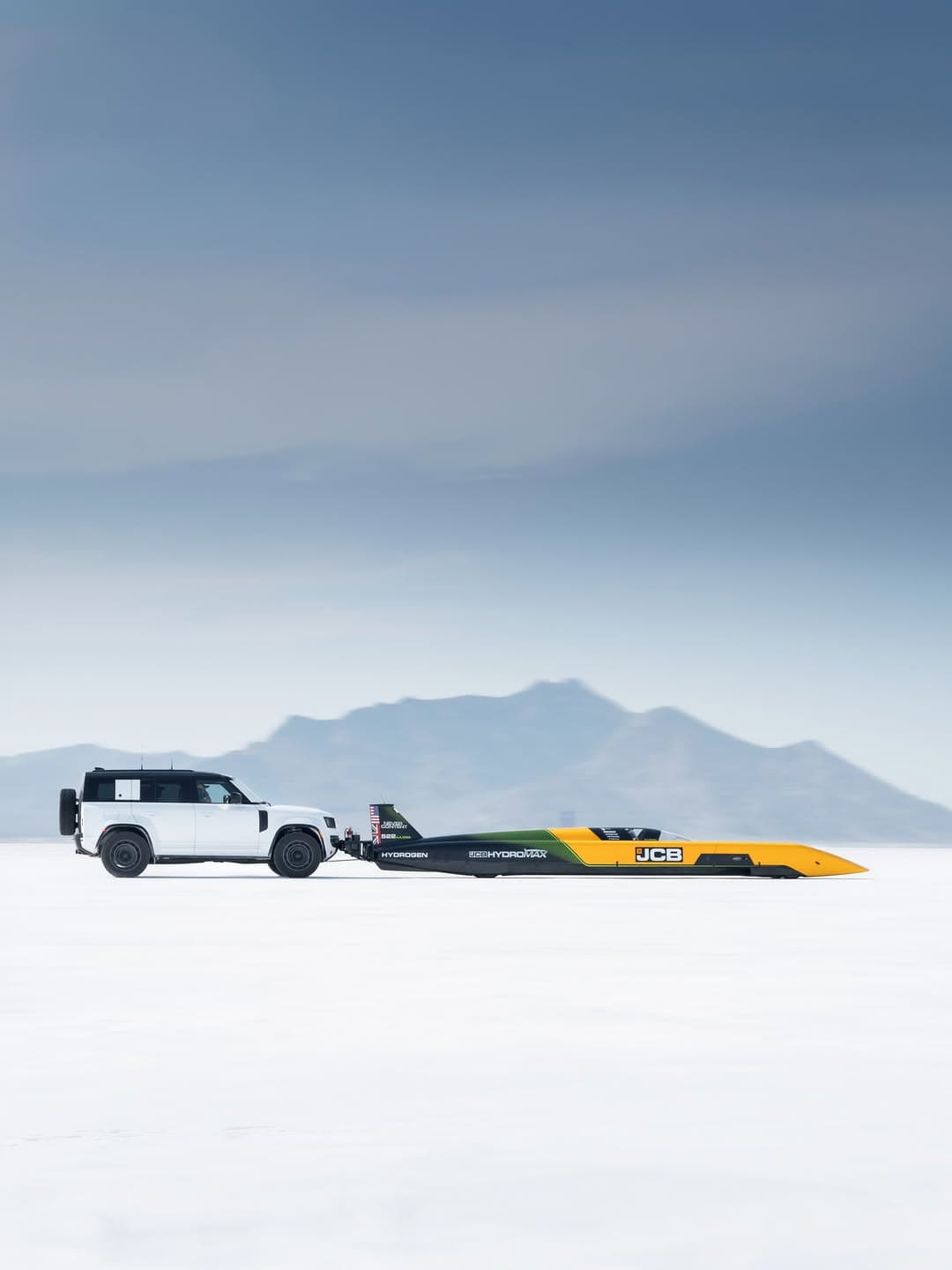
The land speed record has always belonged to a particular kind of theatre, the wide white stage of Bonneville, the horizon that refuses to blink, the small human insistence that the future can be measured in miles per hour. This week, that theatre acquired a new scent in the air, not petrol and bravado, but hydrogen combustion and intent. JCB has set a new FIA world mark with its hydrogen combustion powered JCB Hydromax, clocking 406.320 mph at the Bonneville Salt Flats, with support from Defender.
It is tempting to treat any record as a blunt number, a tidy headline, a moment to clap and scroll on. But the land speed record, when it is done properly, is more like architecture. Every decision reverberates. The wind becomes an editor, the salt becomes a critic, and the machine is required to be both elegant and brutally honest. At 406.320 mph, there is no room for a vague idea masquerading as engineering.
Land speed record, reimagined for the hydrogen era
Hydrogen is often discussed as a promise, sometimes as a problem, and too rarely as something you can actually hear, see, and test under pressure. What JCB has done at Bonneville is drag that conversation out of conference rooms and into the glare of a place that has embarrassed plenty of ambitious projects. A land speed record is not a marketing line, it is an outcome, and Bonneville has never been polite about separating the two.
The record also lands at a moment when car culture is recalibrating its sense of what constitutes romance. For years, the story has been told as a binary, nostalgia versus progress, noise versus silence. Hydrogen combustion complicates that, offering propulsion that still speaks in mechanical language, while pointing toward a different kind of fuel future. It is not a sermon. It is proof of concept at full volume.
Why Bonneville still matters
There is an intimacy to Bonneville that photographs rarely capture. The salt looks like snow until you step onto it, and then it reads as mineral, hard, slightly hostile. Light bounces up from the ground and flattens everything, which means the vehicle cannot hide behind shadow or drama. You see the stance, the proportions, the reality. A record set here carries an old fashioned credibility precisely because the setting is so unadorned.
The supporting cast, Defender OCTA as push vehicle
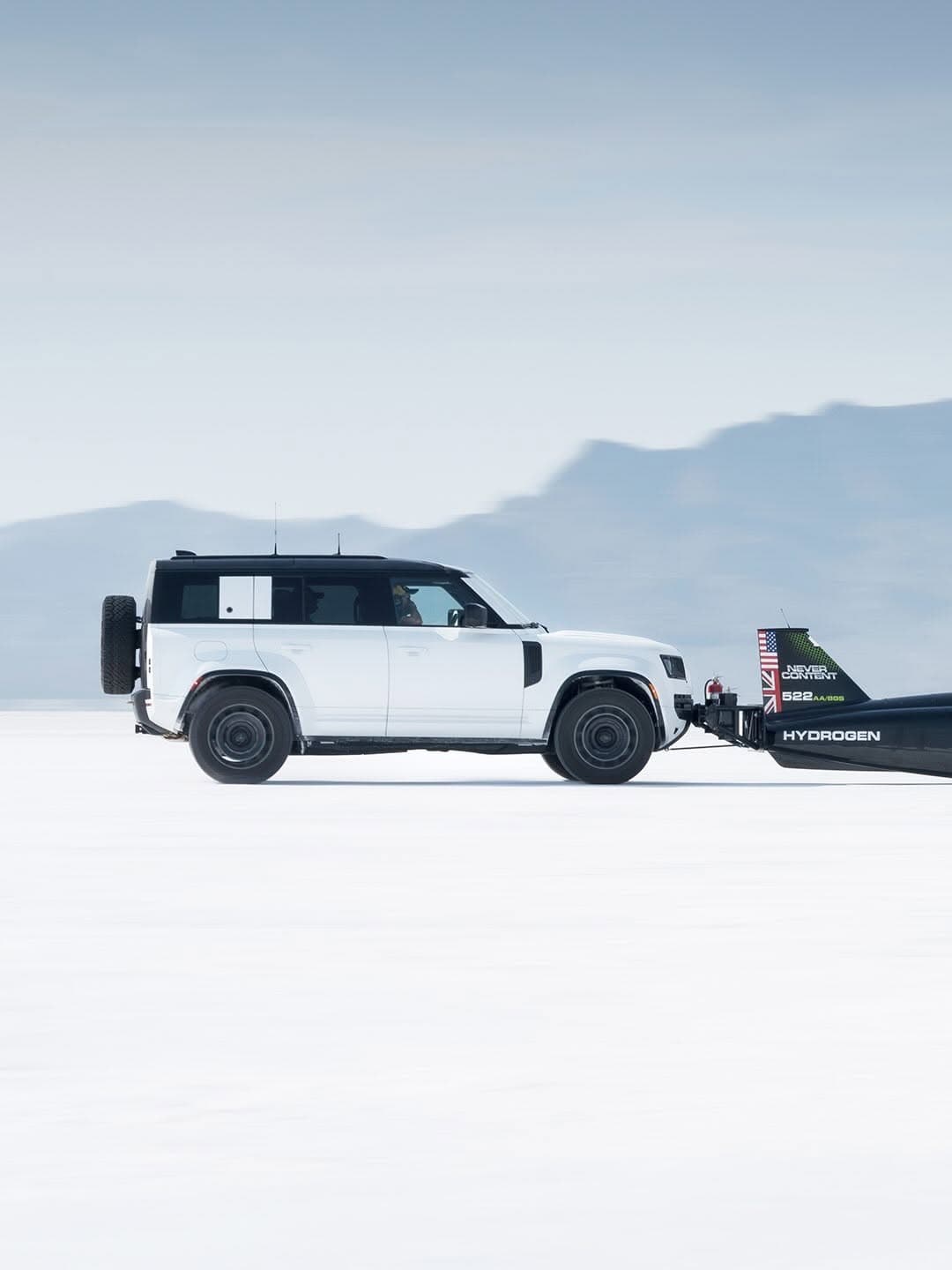
Even the most headline friendly achievement is built on the unglamorous details. Defender supported the run with an OCTA push vehicle, and the specifics are the kind that matter when the work is real. An integrated winch mounted push plate, a 635PS twin turbo V8, and 6D dynamic suspension are not decorative phrases. They are the difference between a clean launch and a compromised attempt, between momentum and friction at the exact moment it counts.
In the luxury world, we love to fetishise the hero object, the single item that carries the fantasy. Motorsports and record attempts rarely work that way. They are ensembles. The push vehicle is the stagehand you never see, except here the stagehand is a brutally capable piece of modern performance engineering, doing its job with the quiet competence Defender owners tend to prize.
Performance, but make it purposeful
There is a particular satisfaction when performance hardware is used for something more interesting than ego. The Defender OCTA’s role at Bonneville reads like an antidote to empty flexing, power deployed as a tool. That is a subtle but important cultural shift, especially as the broader automobile conversation becomes more values driven. If you care about what comes next, you start to care about how power is applied, not simply how loudly it announces itself.
What this land speed record signals in the culture of speed
Records are rarely just records. They are signals, sometimes warnings, sometimes invitations. A hydrogen combustion land speed record at 406.320 mph suggests that the next era of speed will not be a single lane highway, but a multi route map. Battery electric will continue to define much of the public imagination, but hydrogen, in its own way, is insisting on a seat at the table, especially where energy density, quick refuelling, and hard use are part of the brief.
It also reframes what we look for in “sustainable” performance. The worst version of the future is one where responsibility is packaged as deprivation. Bonneville, in its stark beauty, refuses that narrative. It says you can still chase velocity, still engineer for extremity, still make a machine that captivates, and simply change what you feed it.
Where to follow the evolving story
We will always make room for fashion’s runway drama, but the salt flats have their own kind of style, stripped back and serious. If you are tracking how design, prestige, and technology meet in the real world, begin with our Automobile coverage, then widen the lens through Luxury and the bigger conversations in Culture. Because a land speed record is never just about the machine, it is about what we decide to celebrate.
Bonneville has always rewarded clarity. You arrive with a thesis, you either defend it against air and salt and physics, or you go home with excuses. JCB arrived with hydrogen combustion and left with 406.320 mph. The land speed record now carries a new accent, and it sounds a lot like the future refusing to wait politely.
Photo Credits
Images courtesy of their respective owners.