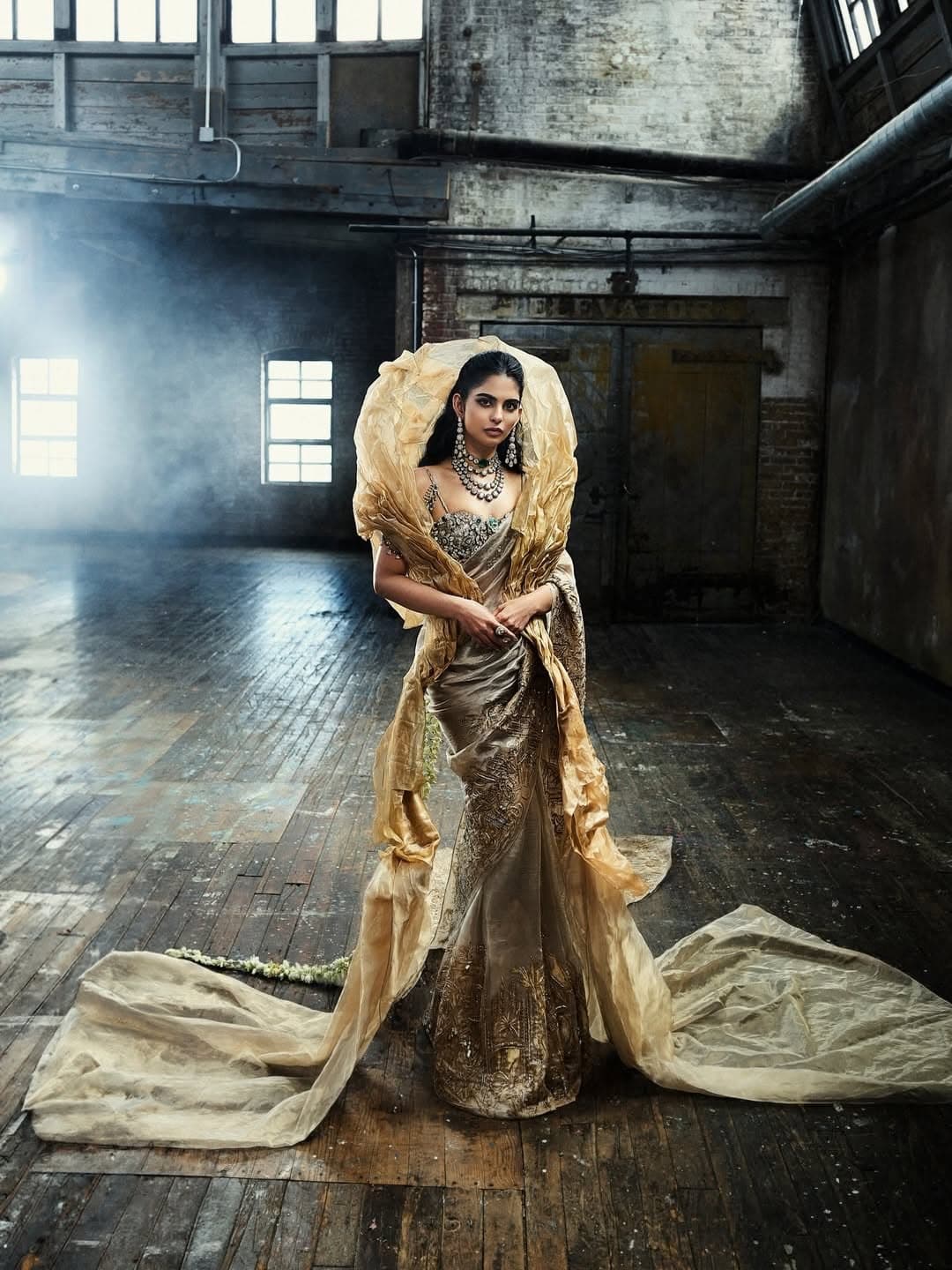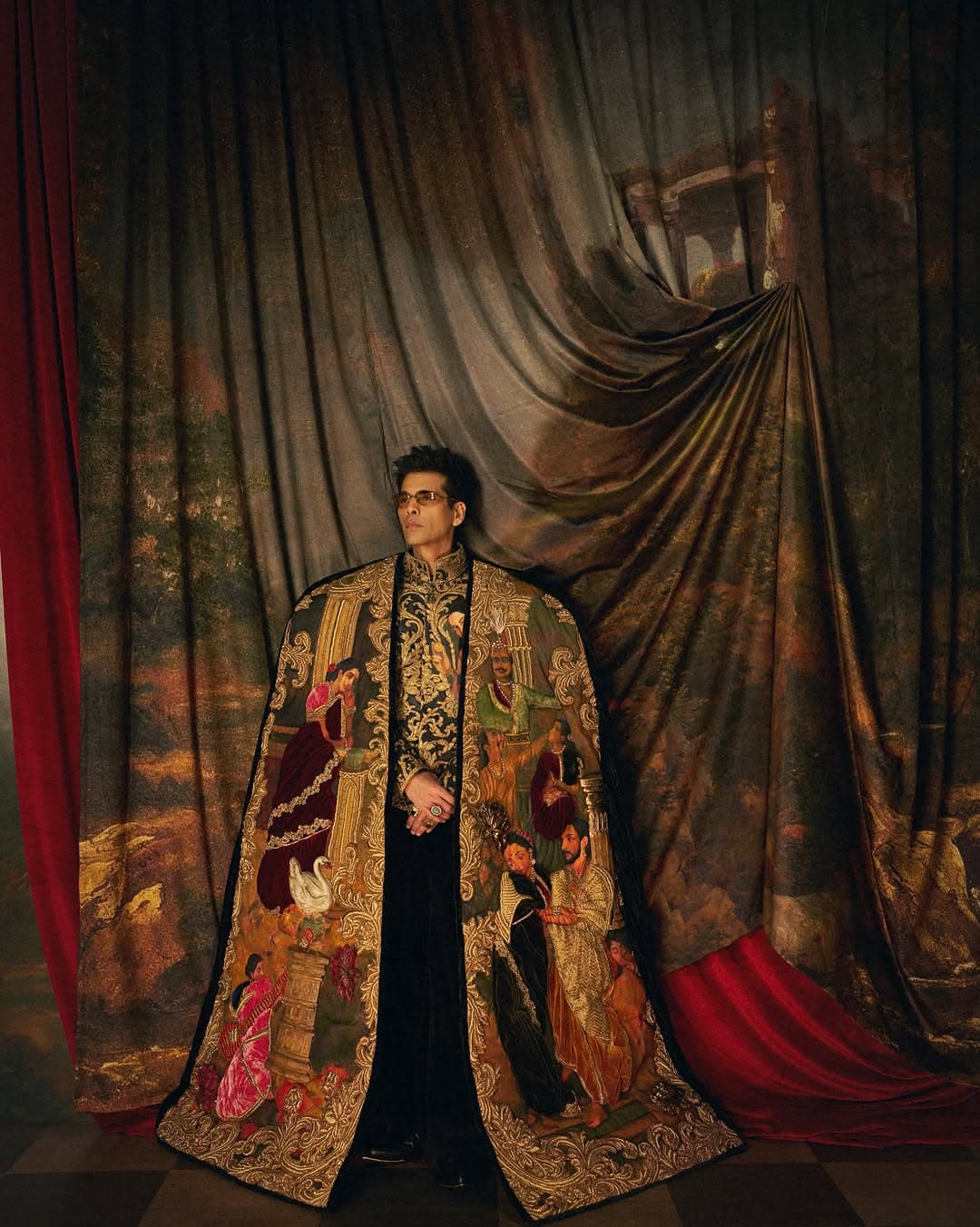
There’s a particular kind of glamour that doesn’t flirt with time—it arrests it. Framed In Eternity arrives with that hush: the kind you feel in a museum gallery just before you lean in, close enough to catch the brushstrokes. Inspired by Raja Ravi Varma, it isn’t interested in nostalgia for nostalgia’s sake. It wants the old India—myth, mood, majesty—to look you straight in the eye, and then follow you out into the street.
Raja Ravi Varma felt right because his work did what cinema, at its best, still struggles to do without trying too hard: he painted feelings. Not just faces—temperament. Desire. Dignity. A loneliness you can’t name but instantly recognize. That’s the emotional temperature this story carries, stitched into couture and posed like a living tableau.
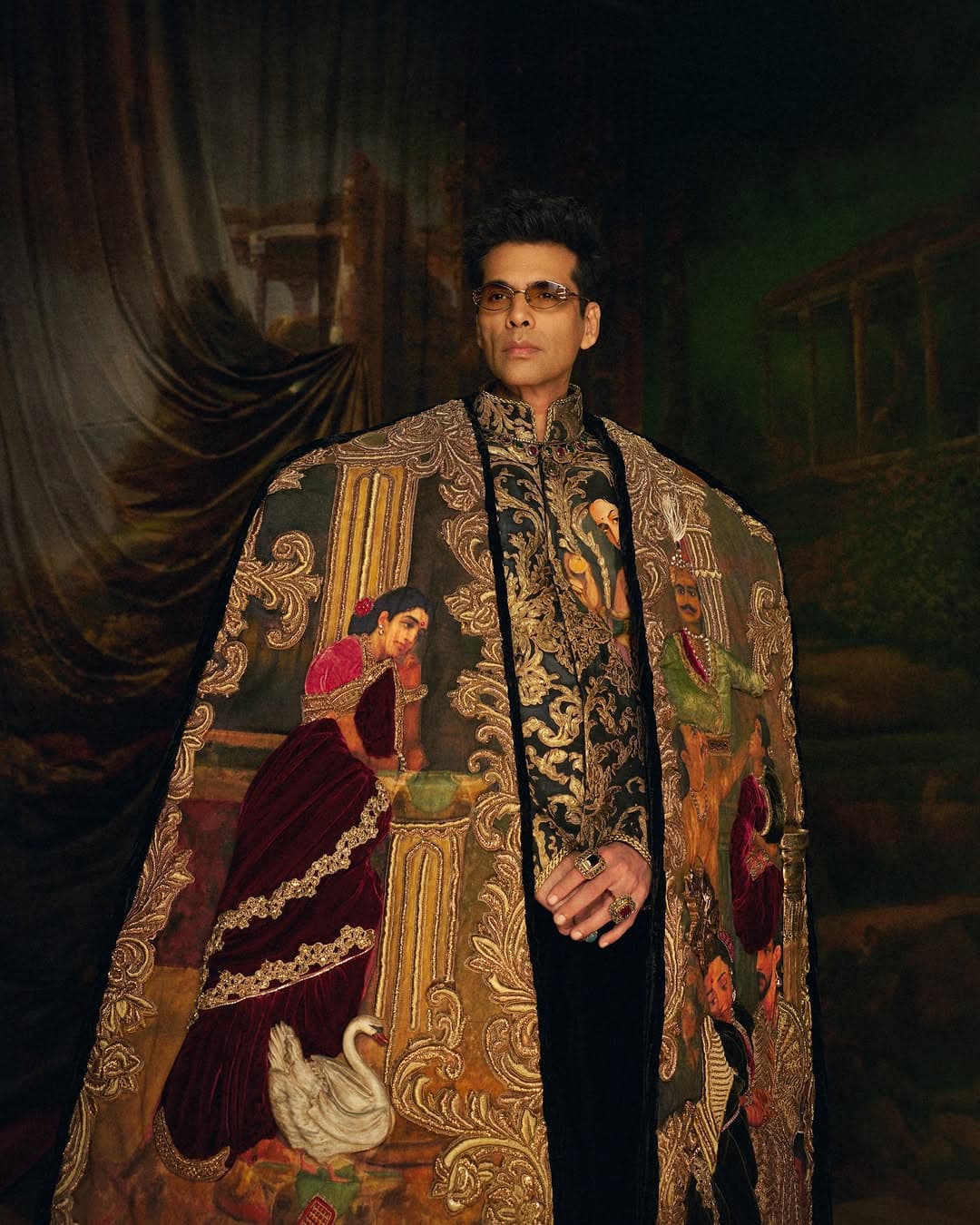
Framed In Eternity: The Raja Ravi Varma Moodboard, Recut for Now
Varma’s women are never merely beautiful; they’re composed. They occupy space the way a good leading lady does—quietly, decisively, with intention behind the eyes. In Framed In Eternity, that intent translates into a fashion vocabulary that doesn’t pander. The silhouettes hold their ground. The embellishment reads like punctuation, not noise. And the gaze—always the gaze—does the heavy lifting.
If you want a primer on why Varma matters beyond calendar art and reproductions, start with his place in Indian art history: a bridge between European academic realism and Indian storytelling, between the court and the public imagination. That bridge is exactly where modern Indian fashion is most potent—when it doesn’t dilute itself for global approval, but edits itself with confidence.
Why this reference hits differently in 2026
We’re living through an era of maximal visuals and minimal feeling—perfect lighting, empty heart. What makes Framed In Eternity land is its refusal to be purely aesthetic. It’s emotional styling. It’s narrative glamour. And yes, that’s a little provocative in a culture that too often confuses “opulent” with “overdone.”
For more on how Indian craft becomes contemporary without losing its soul, bookmark our guide to modern Indian couture and this take on maximalism that actually feels intelligent.
Manish Malhotra, the Master of Cinematic Craft
And who better—truly—than Manish Malhotra, the oldest partner in crime and fashion, to make the concept feel lived-in rather than staged? Malhotra has mastered a rare art form: translating Indian culture to a global stage without sanding off its edges. Couture, in his hands, is less “fantasy” and more “memory”—the kind you can wear.
His work has always understood the camera (and the woman) as collaborators. That’s why the line “You made me feel like a canvas for your art” rings true. With Malhotra, the wearer doesn’t disappear beneath craft; she becomes the point of it.
To understand the house language—its embroidery codes, its Bollywood lineage, its consistent insistence on polish—start where it’s meant to be seen: Manish Malhotra’s official site.
The supporting cast: eyewear, jewels, shoes (and why they matter)
Luxury styling is never about “adding.” It’s about calibrating.
- Eyewear: Anna-Karin Karlsson—high drama, sculptural, unapologetically editorial (exactly the right jolt against classical referencing). Explore the brand universe at Anna-Karin Karlsson.
- Jewellery: Tyaani’s neckpiece and rings bring that heirloom cadence—precious without feeling costumey, regal without stiffness. The effect is “family vault,” not “borrowed sparkle.”
- Footwear: Copper Mallet grounds the look with modern attitude—because a contemporary Varma muse would absolutely know the power of a decisive shoe.
Styled by Eka Lakhani, with India and New York teams operating like a well-rehearsed production unit, the final image feels less like a shoot and more like a scene—blocked, lit, and emotionally directed. Hair and makeup—Aalim Hakim and Paresh Kalgutkar in India, Avan Contractor and Marissa Machado in New York—keep the beauty firmly in the realm of “finished” rather than “fussy.” (A crucial distinction.)
The Editorial Take: Cultural Luxury Isn’t a Costume
Here’s the thing about referencing heritage: it can either feel like homage or like dress-up. Framed In Eternity chooses homage, and you can sense the gratitude in the construction. The global stage doesn’t require less India; it requires better editing, stronger point of view, and the confidence to let cultural specificity be the flex.
If this mood speaks to you—the intersection of art history and contemporary style—consider pairing it with our edit on wearing couture without feeling like you’re in a costume drama. Because modern glamour isn’t about volume; it’s about conviction.
Who made the frame
Behind the images: management by Lenn Soubam; India photoshoot by The House of Pixels; art direction by Amrita Mahal Nakai; BTS videography by By The Gram Studios. It reads like credits at the end of a film for a reason—this is fashion as production, not mere portrait.
Framed In Eternity isn’t asking you to time-travel. It’s asking you to remember that style can carry story—and that the most modern thing you can do is feel something, on purpose, in public.
Photo Credits
Cover image courtesy of Karan Johar. Additional images courtesy of their respective owners.