My Dior by Victoire de Castellane has always understood something most jewellery lines forget in their pursuit of spectacle, that intimacy is its own kind of extravagance. This season, the house places that idea in sharp relief with Ever Anderson as its face, a choice that lands not as a casting gimmick but as a quiet thesis statement. Dior’s codes, that calibrated mix of softness and structure, look uncannily at home on her, as if the pieces were designed for a life lived between rehearsal, real life, and the particular theatre of Paris.
There is a reason My Dior endures inside Dior’s fine jewellery universe. Castellane, Dior’s Artistic Director of Jewellery since 1998, has built her legacy on taking the maison’s most recognisable motifs and making them feel less like heritage and more like emotion. In My Dior, that emotion is translated into a lattice, a cannage like weave in precious metal that nods to the Napoleon III chair backs in Christian Dior’s salons and the graphic architecture of the Lady Dior bag. It is Dior at its most legible, and, at its best, its most personal.
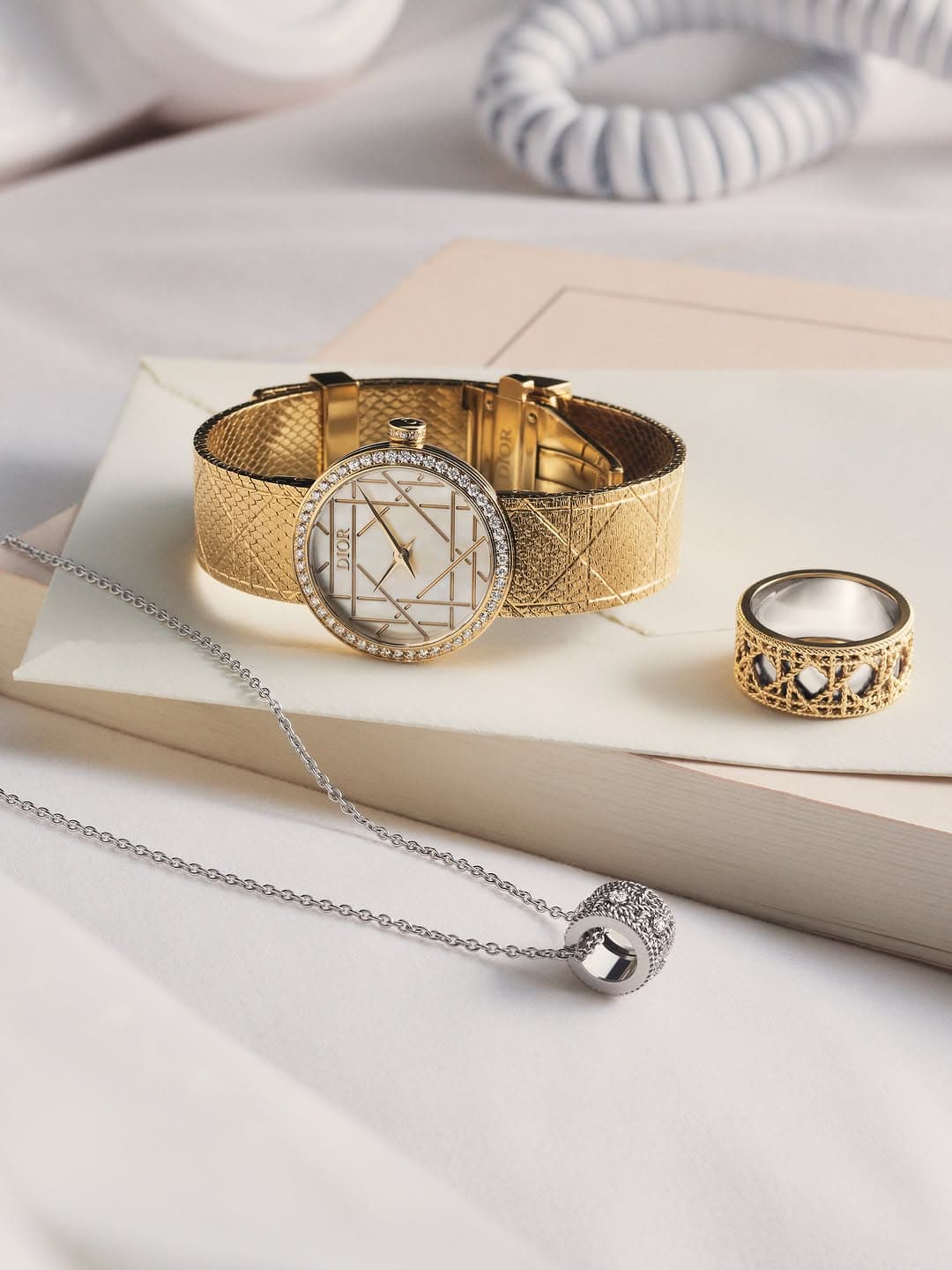
My Dior by Victoire de Castellane, the cannage that behaves like lace
The pleasure of My Dior is how it moves between disciplines without ever feeling like product placement for the brand’s other icons. The cannage pattern is the key, a repeating geometry that could read strict, yet Castellane makes it behave like lace. In the best iterations, the metal seems to have air in it, as though the piece was cut from a couture toile rather than cast in a workshop. You notice it most in the way the light catches the edges, not as a blunt sheen, but as a series of small flashes, the visual equivalent of silk thread pulled taut.
Dior has never been shy about turning its house codes into a kind of grammar, and My Dior is fluent. This is the line that sits comfortably beside the Lady Dior’s cannage and the maison’s couture heritage, yet refuses to be merely referential. It is jewellery with an interior life, designed to be worn close and often, as naturally as you reach for a favourite white shirt, or a scent you keep returning to because it smells like yourself.
The Victoire de Castellane signature, maximalism with manners
Castellane’s broader oeuvre is often described as exuberant, and it is, but what keeps it from noise is her sense of control. Even when she works in bright stones and bold volumes, there is an underlying architecture. In My Dior, that architecture is the grid, softened by rounded corners and, in diamond set versions, a kind of frosting that never tips into heaviness. The overall effect is graphic but not cold, feminine without being precious, and distinctly Dior, that is to say, rigorous.
If you want context for how intentionally Dior builds these visual codes across categories, spend five minutes looking at the house’s own storytelling on Dior.com, where the cannage motif is treated like a living design principle rather than a logo. My Dior sits inside that continuum, but it also stands on its own, especially when worn in stacks, where the pattern becomes almost hypnotic.
Ever Anderson brings a clean lined modernity to My Dior
Ever Anderson’s appeal here is her restraint. She does not over perform the jewellery. She lets it act on the viewer the way good objects do, gradually, through detail. There is also something very Dior about her kind of poise, a mix of classical face and contemporary attitude, which feels aligned with how the house has been presenting its leading women lately, less about the obvious idea of glamour, more about a controlled self possession.
The result is a campaign mood that reads closer to a private fitting than a red carpet. My Dior is not trying to upstage the wearer. It is trying to mark her, lightly, like a signature rather than a headline. In that sense, Anderson is a smart mirror for the line’s best qualities, clarity, a hint of cool, and a softness that reveals itself only up close.
How to buy My Dior now, in store and on Dior.com
My Dior is available in boutiques and online, and it is worth approaching the purchase the way you would approach wardrobe building. Decide first whether you want the cannage to read as a quiet texture in polished metal, or as something more luminous with diamonds. The line works best when it becomes part of your everyday rotation, a bracelet that lives beside a watch, a ring you wear when you are not thinking about being seen. For availability and regional selection, start with the official listings on Dior, then confirm in person if you are particular about scale, because My Dior’s proportions matter, especially on the hand.
If you are the sort of reader who likes to triangulate taste across sources, it is also useful to look at how Dior positions cannage historically through their editorial materials and broader fashion context. The pattern’s resonance is not accidental, it is one of the maison’s most persistent visual elements, showing up in handbags, interiors, and jewellery with a consistency that feels almost architectural. For a wider lens on the brand’s design codes and runway point of view, Vogue’s fashion coverage often tracks how these motifs circulate across seasons and creative eras.
Styling notes, the modern way to wear a house code
My Dior shines when you let the pattern do the talking. A single piece against bare skin reads intimate. A small stack reads intentional. Pair it with clean tailoring and the cannage becomes graphic. Wear it with something soft, a slip dress, a cashmere tank, and it becomes a kind of punctuation. The key is not to match it to other Dior codes too literally. Let it live as an object with its own identity, not a souvenir.
For more jewellery coverage with an editorial eye, visit Luxury on bestmagazine.ca, and for a broader runway to real life perspective, our Fashion section tracks the pieces that earn their relevance beyond a single season. If you are watching the rise of new campaign faces and what they signal culturally, Celebrity is where we pull those threads with a bit more intention.
Ultimately, the success of My Dior by Victoire de Castellane is that it does not ask you to believe in fantasy. It asks you to believe in craft, in motif, in the idea that a grid of gold can feel as tender as fabric. With Ever Anderson, Dior frames that tenderness as modern, not nostalgic. And that is the trick, to make a house code feel less like branding and more like belonging.
Photo Credits
Cover image courtesy of Dior Official. Additional images courtesy of their respective owners.