There are watches that perform for the room—and watches that perform for the person wearing them, quietly, brilliantly, without demanding a user manual or a second espresso. The Richard Mille RM 003 sits firmly in the latter camp: sophisticated enough to make seasoned collectors lean in, practical enough to make you forget you’re wearing something technically ferocious. That balance—seduction and sense—is precisely the brand’s north star, and it’s why the RM 003 remains one of the most wearable “complication-first” statements of the early 2000s.
Because let’s be honest: travel watches can get precious. Too many world-timers turn into wrist-bound atlases; too many GMTs feel like a homework assignment. The RM 003, by contrast, offers a second time zone with the kind of user-friendly clarity that feels almost… impolite in its confidence.
Richard Mille RM 003: A second time zone, made strangely simple
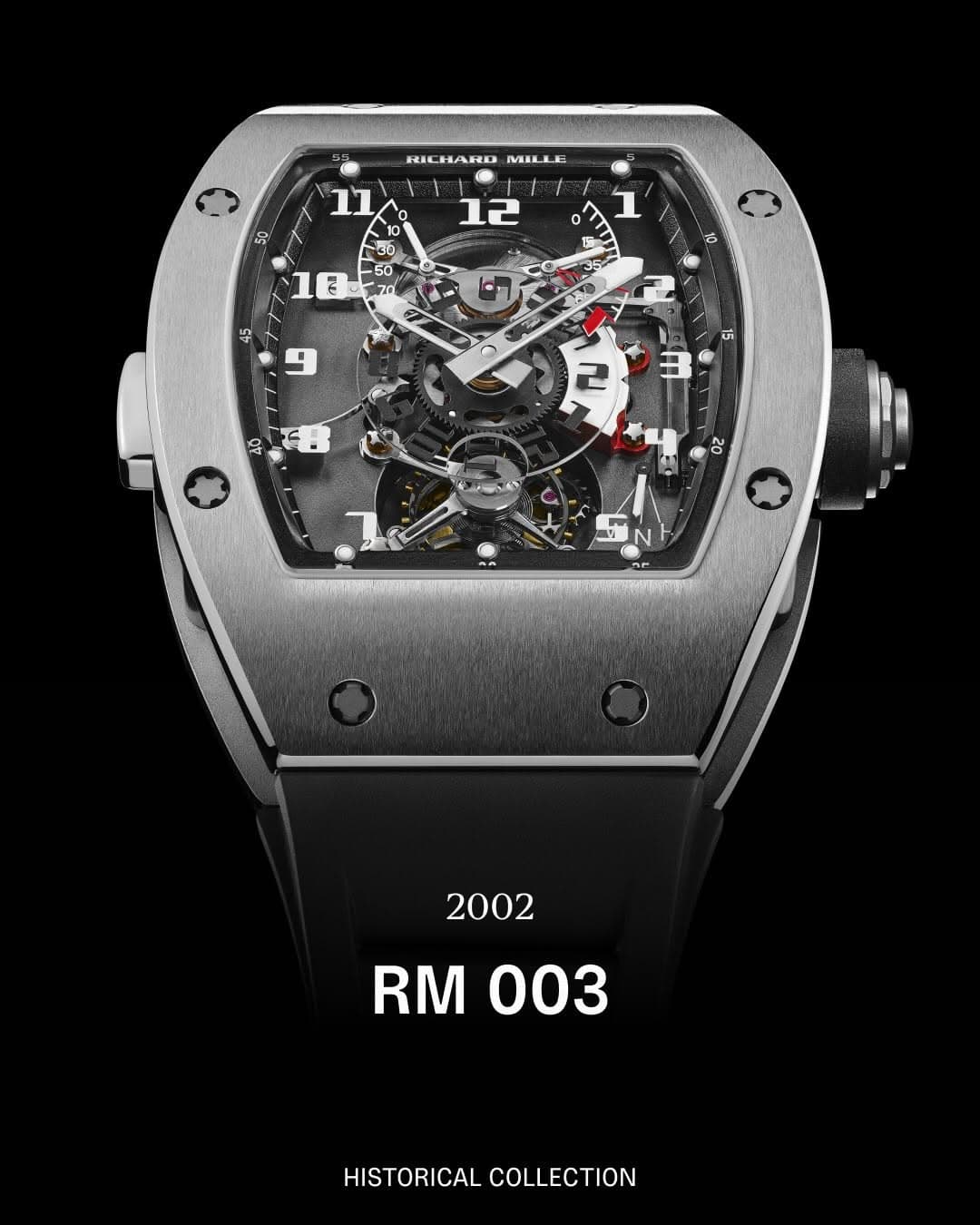
Released in 2002, the RM 003-V1 shares the muscular, architectural charisma of the RM 002-V1—same family bones, same sense of a machine designed with the audacity of a concept car. But it distinguishes itself with a central second time zone disc that’s as technically complex as it is clean to read. The trick is a transparent sapphire crystal disc, inscribed with hours, rotating continuously within the movement. The numerals only reveal themselves when they pass over a crisp white background at 3 o’clock. It’s a little theatre of legibility: discreet until it isn’t.
That design choice feels very Richard Mille—high-tech materials doing haute-couture work. Think of it as the horological equivalent of a sheer dress engineered with invisible structure: the mechanics do the heavy lifting, the wearer gets the ease.
Why the sapphire disc matters (yes, even if you “don’t do” complications)
Most dual-time displays announce themselves loudly—extra hands, extra dials, extra fuss. Here, the solution is elegant in the way good industrial design always is: it vanishes when it doesn’t need your attention. For anyone who actually moves between cities (or even just lives between calendars), that kind of calm functionality is luxury.
The movement story: titanium, ARCAP, and the AP Renaud & Papi collaboration
The RM 003-V1 was the third calibre developed by Richard Mille in collaboration with Audemars Piguet Renaud & Papi—the movement specialists collectors reference the way fashion people reference ateliers. (If you know, you know.) The baseplate and bridges are executed in grade 5 titanium and ARCAP, and the watch adopts the fundamental mechanical architecture of the RM 002, including the signature function selector plus torque and power reserve indicators.
There’s a particular pleasure in a Richard Mille dial: not the joy of “pretty,” but the satisfaction of systems. Like standing in front of a beautifully organized kitchen where nothing is ornamental, yet everything looks good. The indicators aren’t there to decorate; they’re there to keep the watch honest.
For context on the broader brand philosophy and what made early Richard Mille so disruptive, a quick look at Richard Mille on Wikipedia is a helpful refresher—though it doesn’t quite capture how radically modern these watches felt in the early 2000s, when “sport luxury” still meant a steel bracelet and a certain Swiss conservatism.
RM 003-V2 (2005): carbon nanofibre and the runway to travel-oriented watches
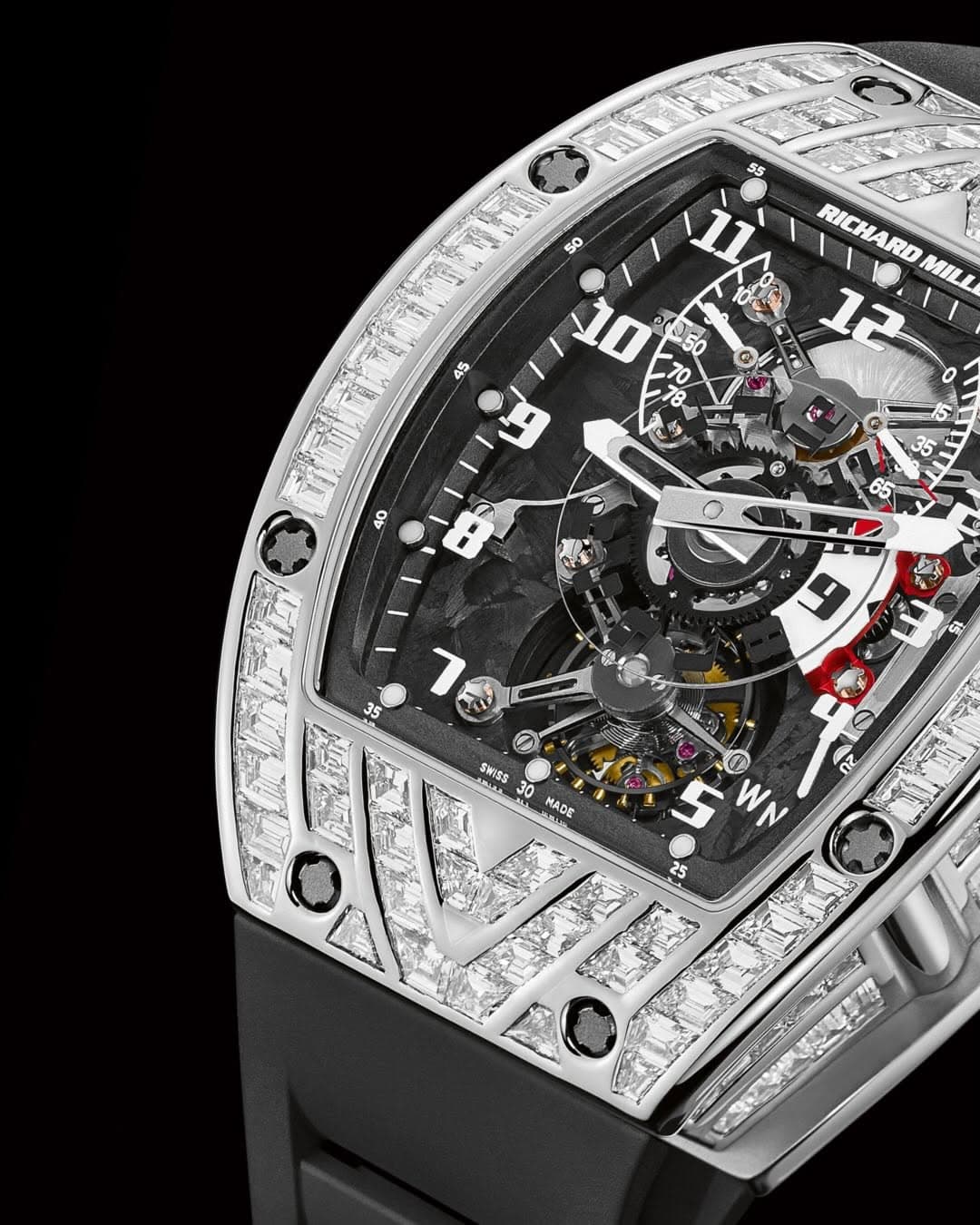
By 2005, the RM 003-V2 arrived with a detail that, at the time, read like a manifesto: a carbon nanofibre baseplate. Like all V2 versions from that period, the material change wasn’t a cosmetic flex—it raised the technical stakes, adding an extra layer of challenge while hinting at where the brand was heading. The RM 003-V2 effectively paved the way for Richard Mille’s increasingly travel-oriented timepieces, the ones that would later become shorthand for jet-set capability (and, inevitably, a certain modern status signal).
Carbon nanofibre doesn’t just sound futuristic. It is. And it underscored what the RM 003 did so well: treat daily usability as the ultimate luxury. The watch doesn’t beg to be babied; it’s built to come with you.
What makes the RM 003 feel “comfortable,” beyond the strap
- Legibility that appears on cue: the second time zone reveals itself only when needed, thanks to the white-backed window at 3 o’clock.
- Information architecture: torque and power reserve indicators are laid out with the logic of an instrument panel, not a decorative dial.
- Material intelligence: grade 5 titanium and ARCAP in the V1; carbon nanofibre in the V2—each choice made in service of performance and wearability.
The editorial take: the RM 003 is the rare flex that’s also considerate
It’s fashionable to talk about “quiet luxury,” but the RM 003 complicates that conversation in an interesting way. Visual quiet? Not exactly—this is still a Richard Mille, still unapologetically technical, still engineered to look like it’s doing something (because it is). But as an experience, it’s remarkably considerate. The complication is there to serve you, not to show off at dinner.
If you’re building a wardrobe of objects—watches included—that prioritize intelligent design over performative heritage, the RM 003 belongs in the same mental folder as a perfectly cut The Row coat or a Rimowa cabin case that’s been everywhere and still glides. For more on that modern collector mindset, you might enjoy our take on quiet luxury accessories and how taste has shifted from logos to engineering.
And if you’re considering the RM 003 specifically as a travel companion, pair this read with the best luxury travel watches we’d actually recommend for people who board planes more than they post about them, as well as how to start a watch collection without falling into the usual cliché traps.
To see the brand’s current universe—and to understand how far those early material experiments have traveled—browse the official Richard Mille website. For the deeper mechanics of what a GMT/dual-time is actually doing when it’s done well, GMT on Wikipedia is a tidy explainer.
Still, the RM 003’s real charm isn’t in the citations. It’s in the daily moment: you glance down, you know where you are—and where you’re going next—without a fuss. That’s not just sophistication. That’s consideration. And in luxury, that’s rarer than we like to admit.
Photo Credits
Cover image courtesy of Richard Mille Legacy. Additional images courtesy of their respective owners.