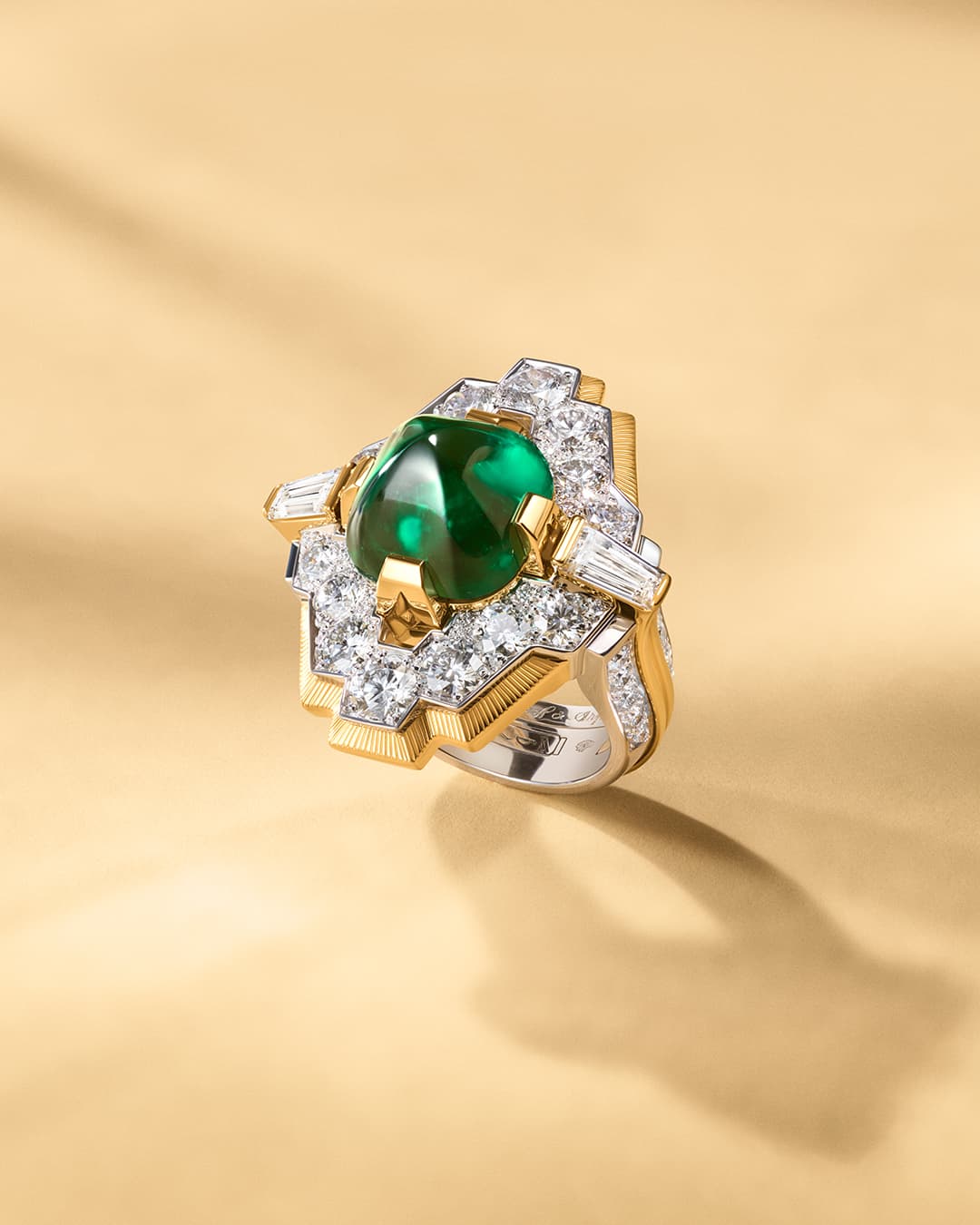
There are jewels that announce themselves with size, and jewels that win you over with the way they solve a design problem. The Van Cleef & Arpels emerald ring in the Maison’s Egypt inspired high jewelry narrative belongs to the second camp, a piece that turns geometry into a point of view. At its center sits a sugarloaf emerald of 8.47 carats, domed, polished, and edged with a cut that makes the stone feel architectural rather than merely precious.
The Van Cleef & Arpels emerald ring, built like a monument
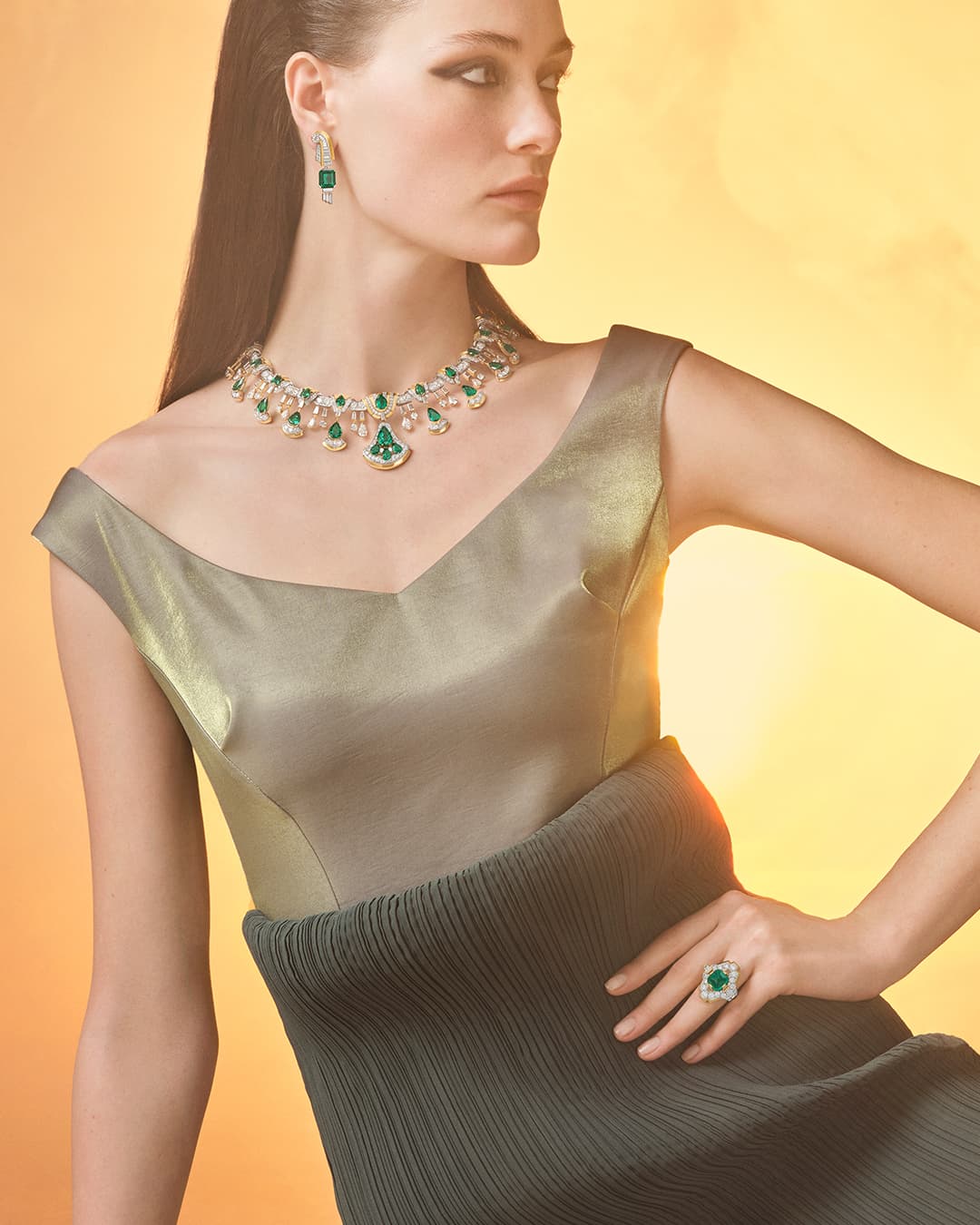
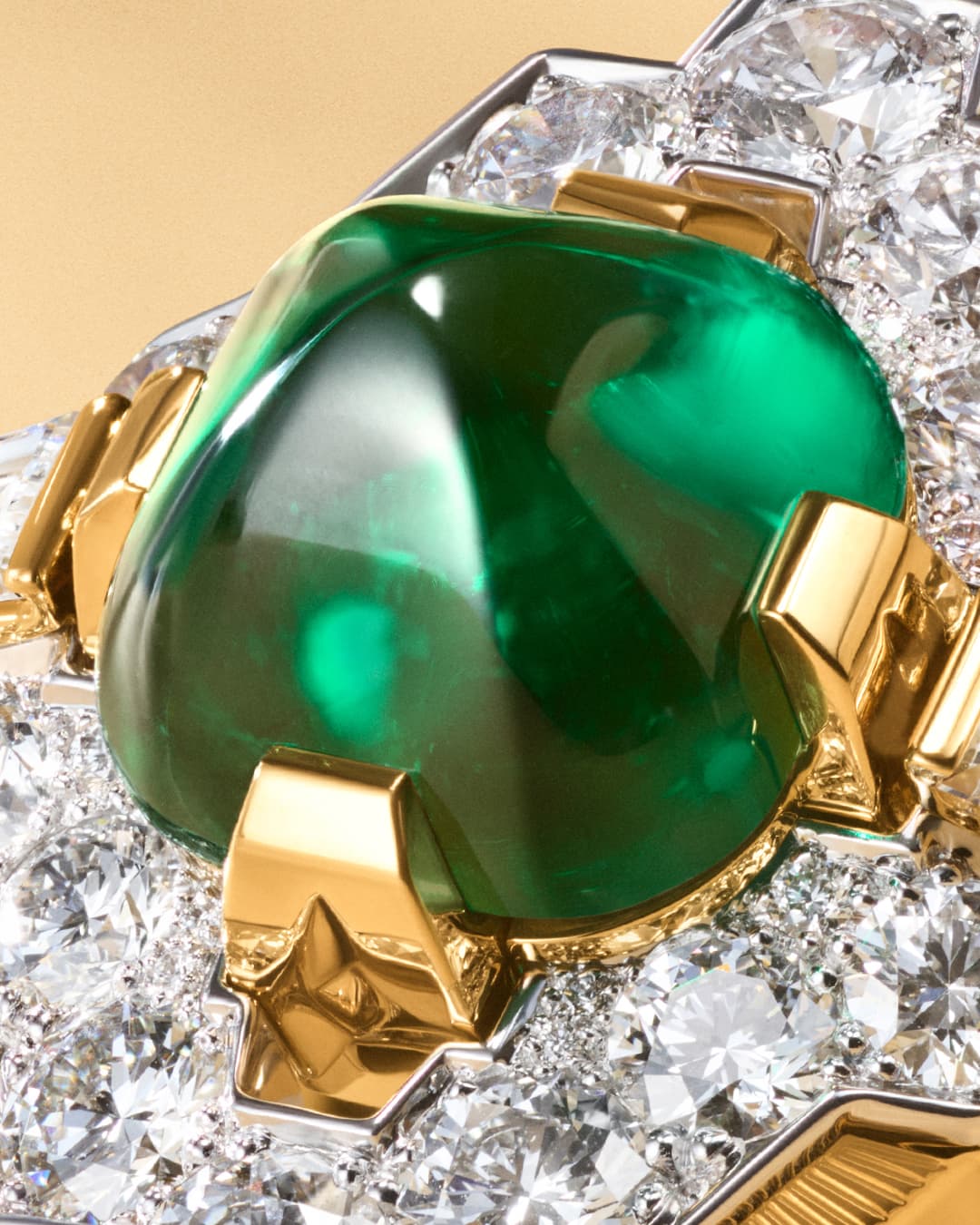
Van Cleef & Arpels names it the Cardinal d’émeraude ring, and the caption that accompanies the piece is unusually specific about its intentions. The stone is described as a sugarloaf emerald of 8.47 carats, distinguished by cut sides and rounded edges. That detail matters, because sugarloaf cuts can drift into softness. Here, the sharpened flanks pull the eye outward, so the gem reads as volume with corners, a small engineered structure.
The ring’s silhouette explicitly “evokes the shape of ancient step pyramids,” a cue reinforced by the prongs’ form and an openwork structure. Instead of hiding the mechanics, the setting makes them part of the composition. You can see how the metalwork frames the stone in tiers, like an elevation drawing translated into gold and negative space. It is not just an emerald presented on a band, it is a miniature piece of architecture whose load bearing logic is made visible.
Fascinating Egypt: when high jewelry borrows from archaeology
The hashtags point to #VCAFascinatingEgypt and #VCAHighJewelry, positioning the ring within Van Cleef & Arpels’ ongoing habit of treating history as a design library, not a costume trunk. Egypt is a particularly demanding reference, because it comes with instant symbols that many houses lean on too literally. Here, the idea lands through structure, not surface. The pyramid is there in the ring’s massing and the way the setting steps upward toward the stone.
That is also why the sugarloaf emerald is a canny choice. Its domed top gives the piece a sense of ascent, while the cut sides keep it from becoming purely ornamental. In high jewelry, this is where wearability and philosophy meet: an object that can sit on the hand all evening, yet still behave like a concept model.
What to look for in the setting
Even in still images, the most telling features are structural: the prongs that echo the stepped profile, and the openwork that lets light travel through the undergallery, sharpening the stone’s presence. If you are tracking Van Cleef & Arpels high jewelry for craft rather than celebrity placement, this is the sort of piece that rewards a second look, first at the emerald and then at everything holding it in place.
Where this ring sits in Van Cleef & Arpels high jewelry
Van Cleef & Arpels has long treated nature, ballet, and world cultures as recurring chapters. The Egypt thread signposted by VCA Fascinating Egypt pushes the Maison toward a more architectural vocabulary: stepped forms, graphic symmetry, and a more assertive relationship between gemstone and setting. The result is a Van Cleef & Arpels emerald ring that feels designed from the inside out, starting with cut and structure rather than decoration.
For collectors, the value proposition here is not merely the carat weight, but the clarity of the idea. You can name the silhouette in one sentence, then spend an hour studying how it is achieved.
For more from the house, Van Cleef & Arpels maintains an overview of its high jewelry universe on its official site. The campaign tag #VCAFascinatingEgypt is also used on the brand’s public channels, including Van Cleef & Arpels on Instagram, where the Maison shares pieces and collection context.
Photo Credits
Images courtesy of their respective owners.