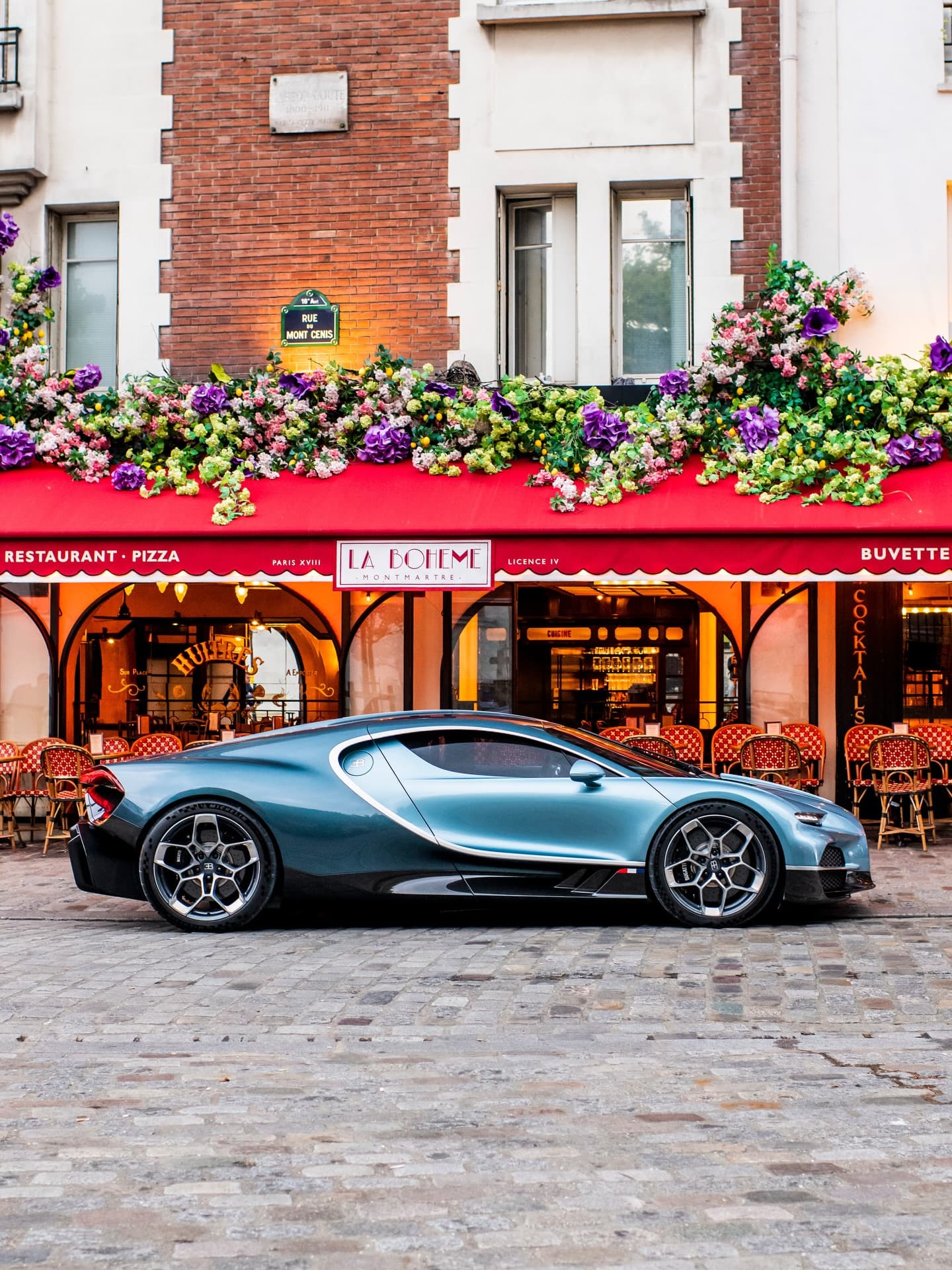
The Bugatti Tourbillon arrives in Paris already speaking the city’s visual language, a machine that wants to be read in boulevards and stone, in river light and steep streets. Bugatti’s own caption goes straight for the romance, from the banks of the Seine to Montmartre, but behind the poetry sits a very modern set of facts: a newly revealed hypercar name, a corporate insistence on measurable consumption, and a brand that has always treated Paris as both stage and mirror.
Bugatti Tourbillon, set against Paris

Bugatti positions the Bugatti Tourbillon as an echo of the capital’s “Art de Vivre”, and you can see why that framing remains irresistible. The company’s origin story is French in address and attitude, even as the marque has passed through different eras of ownership and production. Paris functions here as shorthand for a certain type of craftsmanship culture: ateliers, design houses, galleries, and the idea that an object can be engineered to within an inch of its life and still demand to be looked at slowly.
The images lean into that conversation between place and object. Wide façades, bright streets, and a low stance that makes the car appear to skim the surface rather than sit on it. You do not need an invitation to a launch party to understand the intent. Bugatti wants the Tourbillon photographed the way Paris is photographed: as proof of taste, not merely speed.
What the WLTP link signals, and why Bugatti includes it
The caption’s most concrete detail is also the least romantic: a direct reference to WLTP, with Bugatti pointing readers to its consumption page. That matters because WLTP, the Worldwide Harmonised Light Vehicle Test Procedure, is the standardized framework used across Europe to report fuel consumption and CO₂ figures under defined testing conditions. When a manufacturer flags it in a social post, it is a reminder that even a hypercar fantasy exists inside compliance and disclosure.
Bugatti’s link to WLTP consumption information is published here: bugatti.link/consumptionBUGATTI. The practical takeaway is not that a Tourbillon buyer is cross shopping economy numbers. It is that Bugatti is choosing to situate this model in the present tense, where performance mythology shares space with regulatory language and public reporting.
Montmartre as a mood board, not a map
Montmartre is doing symbolic work in Bugatti’s copy. It suggests elevation, drama, a tighter urban grain, and the ritual of climbing toward a view. That makes it a natural counterpoint to the Seine, which is all long lines, bridges, and reflection. Put together, the two locations offer a ready made narrative arc: glide, then ascend.
Yet the Paris references also tell you something about how the Bugatti Tourbillon is being sold. This is not a spec sheet first story. The model is being introduced as an art object with coordinates, meant to be encountered in scenes that already carry cultural weight. If you are interested in how luxury brands use cities as props and proof points, the Tourbillon’s Paris chapter is a crisp example of the technique.
The name choice: “Tourbillon” as cultural code
Bugatti picking “Tourbillon” is a deliberate nod to horology, where the term implies a specific technical solution and a collector’s vocabulary. Even without leaning on unverified claims about the car’s engineering, the naming alone places the Bugatti Tourbillon in a lineage of objects that are purchased as much for connoisseurship as for use.
If this is the direction Bugatti continues to take, expect future imagery to keep tethering the Bugatti Tourbillon to places that come preloaded with meaning, and to keep mixing aspiration with the occasional hard edged link that brings the dream back to earth.
Photo Credits
Images courtesy of their respective owners.