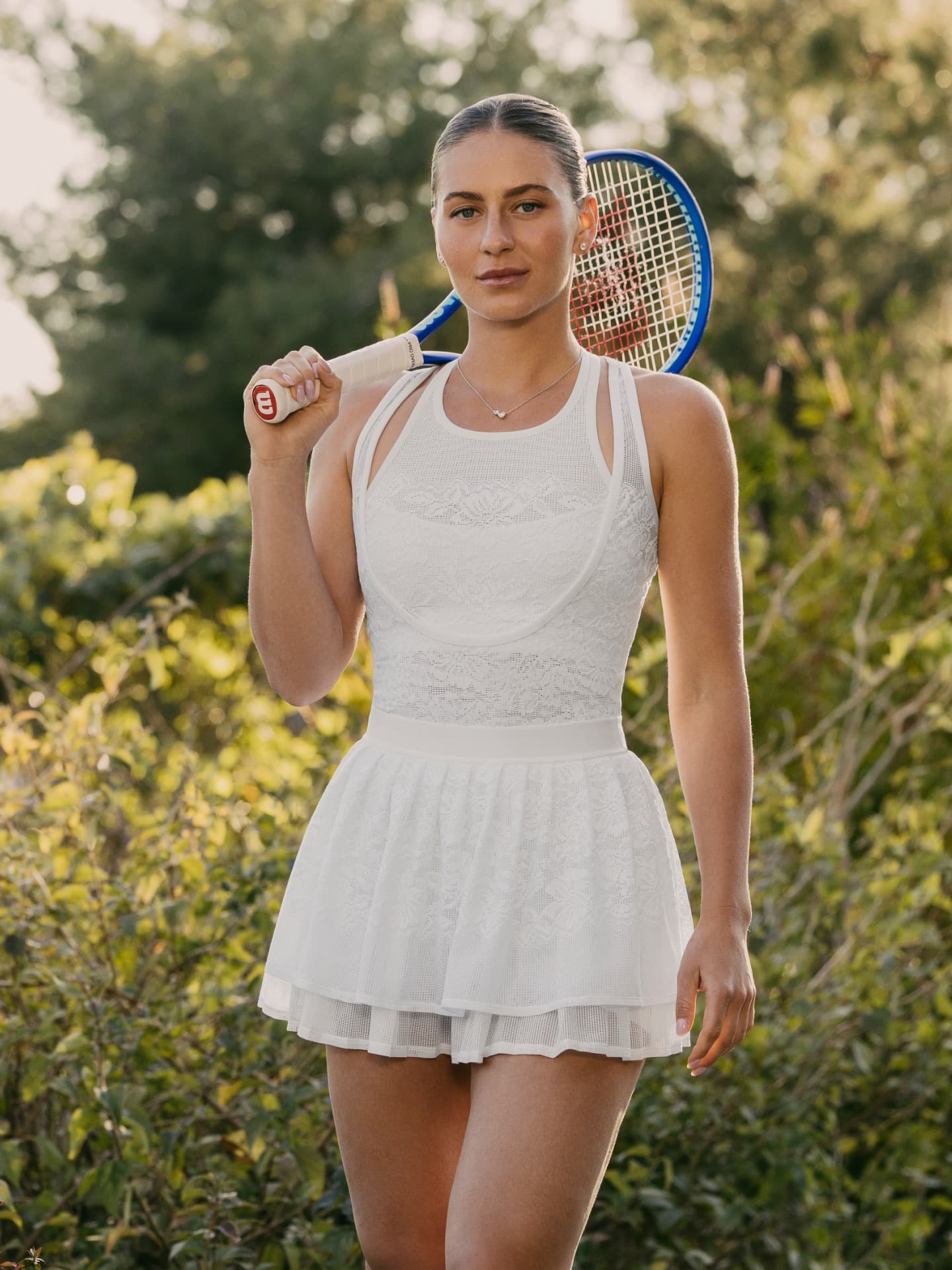
There is a particular tension in modern tennis style: the sport still worships tradition, but the wardrobe is being rewritten by athletes who know exactly what performance feels like from the inside. Wilson Sporting Goods is leaning into that reality with the Wilson Marta Dress, described by the brand as a two piece kit made in all new technical lace for Marta’s 2026 grass slam campaign.
The Wilson Marta Dress, explained without the mystique

Start with what Wilson is actually saying. The Wilson Marta Dress is not positioned as a one off costume moment, but as athlete led design, tied to a specific competitive setting, a 2026 grass slam, and built around a new material story, technical lace. The phrasing matters. When brands invoke lace in tennis, it is often shorthand for vintage romance. Wilson’s language points elsewhere, to a textile engineered to move, breathe, and hold its shape under match conditions, while still reading as lace to the eye.
That combination, performance requirements wearing a decorative surface, is increasingly where tennis kits are heading. Players need garments that tolerate sprinting, sliding, and repeat laundering, while cameras and crowds ask for something with identity beyond a blank skirt and polo.
Why “technical lace” lands differently on grass
Grass is the most symbolic surface in tennis, a stage where clothing codes are policed more tightly than anywhere else. Set against that history, Wilson’s insistence on an “all new technical lace” is a pointed decision. Lace, even when engineered, brings pattern and shadow to a silhouette. It photographs with a built in texture, and on grass that texture can read as deliberate design rather than decoration for its own sake.
Wilson has not publicly detailed the fiber composition, knit structure, or garment spec in the caption tied to this release, so it is worth staying with what can be verified: the brand’s own positioning of this as a two piece kit and a new lace material story, built for a 2026 grass slam moment. If further technical specifications emerge, they will matter because the difference between lace as a concept and lace that survives match play is exactly where athlete led design proves itself.
Athlete-led design is no longer a slogan
The most interesting shift is how openly brands now frame the athlete as a co author. “Athlete led design” used to be a back of house claim, a line slipped into a press release. Now it is the headline, and with the Wilson Marta Dress it is also the justification for making something visually specific for a tournament context that is famously conservative.
In fashion terms, tennis has become a rare arena where a garment has to satisfy three constituencies at once: the player’s body in motion, the sport’s rulebook, and the image economy that turns a match into a global broadcast. A technically driven lace two piece is an attempt to negotiate all three, without pretending they are the same problem.
If Wilson follows through with broader availability and full specifications, the Wilson Marta Dress could mark a useful reference point for where performance kits go next, toward surfaces that are expressive but engineered, rather than expressive instead of engineered.
Photo Credits
Cover image courtesy of Wilson Sporting Goods. Additional images courtesy of Wilson Sporting Goods. Images courtesy of their respective owners.